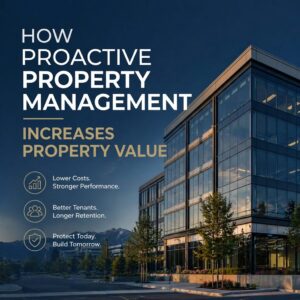
For many commercial property owners, property management is viewed as a necessary expense rather than a strategic function. As long as rent is collected and major issues are addressed, management is often considered “good enough.”
In reality, that mindset can quietly cost owners more over time.
Commercial property management is not just about reacting to problems. When done well, it plays a direct role in protecting asset value, stabilizing cash flow, and reducing risk. Below are some of the most common misconceptions we see and why they matter more than most owners realize.
Mistake #1: Thinking Property Management Is Primarily About Maintenance
Maintenance is important, but it is only one piece of the puzzle.
Strong commercial property management also includes:
-
- Financial oversight and budget tracking
-
- CAM and operating expense reconciliation
-
- Vendor management and contract control
-
- Lease compliance and enforcement
-
- Tenant communication and retention strategies
When management is reduced to maintenance requests and emergency calls, larger issues often go unnoticed until they become expensive problems. Proactive oversight helps identify inefficiencies early and prevents avoidable disruptions.
Mistake #2: Believing Reactive Management Is “Normal”
Many owners accept delayed responses, inconsistent communication, or last-minute problem solving as part of owning commercial real estate.
It does not have to be that way.
Reactive management often leads to:
-
- Deferred maintenance that compounds over time
-
- Frustrated tenants and higher turnover
-
- Rushed decisions that increase costs
-
- Missed opportunities to improve operations
Proactive management focuses on planning ahead. This includes scheduling preventative maintenance, anticipating tenant needs, and addressing issues before they escalate. The difference shows up not only in tenant satisfaction but also in long-term asset performance.
Mistake #3: Overlooking CAM Reconciliation Until It’s Too Late
CAM reconciliation is one of the most critical and most commonly misunderstood aspects of commercial property management.
When handled incorrectly or delayed, CAM reconciliation can:
-
- Create disputes with tenants
-
- Result in unrecovered expenses
-
- Damage trust and transparency
-
- Raise red flags during audits or sale processes
A well-managed CAM process is timely, clearly documented, and communicated consistently. It protects both the owner’s revenue and tenant relationships. Treating it as an afterthought often leads to financial leakage that quietly adds up year after year.
Mistake #4: Assuming Tenant Retention Is Out of Management’s Control
Some owners believe tenant turnover is inevitable and driven solely by market conditions or tenant business cycles.
In reality, property management plays a significant role in tenant retention.
Clear communication, consistent follow-through, and year-round engagement help tenants feel supported and heard. These efforts reduce turnover, stabilize occupancy, and lower leasing and downtime costs.
Tenant retention is rarely about grand gestures. It is about consistency.
Mistake #5: Viewing Property Management as a Commodity
Not all property management firms operate the same way, but many are evaluated as if they do.
Choosing management based solely on fees often overlooks:
-
- Depth of financial oversight
-
- Responsiveness and accountability
-
- Local market knowledge
-
- Alignment with ownership goals
The right property management partner should function as an extension of ownership, not just a vendor. That alignment becomes increasingly important as assets age, tenant mixes evolve, or ownership goals change.
What Strong Property Management Actually Looks Like
Effective commercial property management is proactive, detail-oriented, and strategic. It connects daily operations with long-term objectives and helps owners avoid surprises.
At its best, property management:
-
- Reduces friction
-
- Identifies risk early
-
- Improves transparency
-
- Protects income and asset value
For owners, the question is not whether property management is necessary. The real question is whether the current approach is truly supporting the asset.
Final Thought
Commercial property management should not feel reactive, confusing, or opaque. When expectations are clear and systems are in place, it becomes one of the most effective tools an owner has to protect long-term value.
If nothing else, it is worth asking one simple question:
Is my property management helping me stay ahead, or just keeping up?