The least expensive decision today is not always the least expensive decision for the property.
Every commercial property eventually reaches a point where maintenance becomes a capital conversation.
An HVAC unit fails again. A roof needs another repair. A parking surface continues to deteriorate. Lighting or control systems become increasingly difficult to maintain. Equipment that has operated reliably for years begins requiring more frequent attention.
The immediate question is usually straightforward:
Can we repair it?
The more important question for ownership is often different:
Should we?
Commercial building systems are designed to be maintained and repaired throughout their useful lives. Replacing a major component every time something goes wrong would be unnecessarily expensive.
But there also comes a point when continued repair begins creating its own cost.
Recognizing that point is one of the more important judgments in long-term commercial property management.
The Latest Repair Invoice Does Not Tell the Whole Story
When equipment fails, the most visible numbers are usually the immediate options.
The repair may cost several thousand dollars. Replacement may cost considerably more. Viewed only through that comparison, another repair can appear to be the obvious choice.
Commercial property decisions rarely exist in isolation, though.
The same equipment may have required significant work the previous year. Another component may already be showing signs of failure. Parts may be becoming more difficult to source. Energy consumption may be increasing. Tenants may have experienced repeated disruptions.
The relevant cost is not simply the price of today’s repair.
It is the cumulative cost of continuing to own and operate the system.
That is why maintenance history becomes increasingly important as building components age. A well-maintained record allows ownership to see whether a repair is an isolated expense or part of a larger pattern.
Repair Frequency Can Tell You More Than Repair Cost
An aging system does not necessarily need to be replaced because it required one expensive repair.
Repeated service calls, however, can signal something different.
As equipment ages, owners should pay attention to both the frequency and nature of repairs.
Is the same component failing repeatedly? Are different parts of the system beginning to fail? Is the time between service calls getting shorter? Are repairs becoming more difficult or expensive?
A system that once required predictable preventive maintenance can gradually become one that demands constant attention.
At some point, management is no longer maintaining a reliable building system. It is managing around one that is becoming increasingly unreliable.
Those are two very different operating conditions.
Consider the Difference
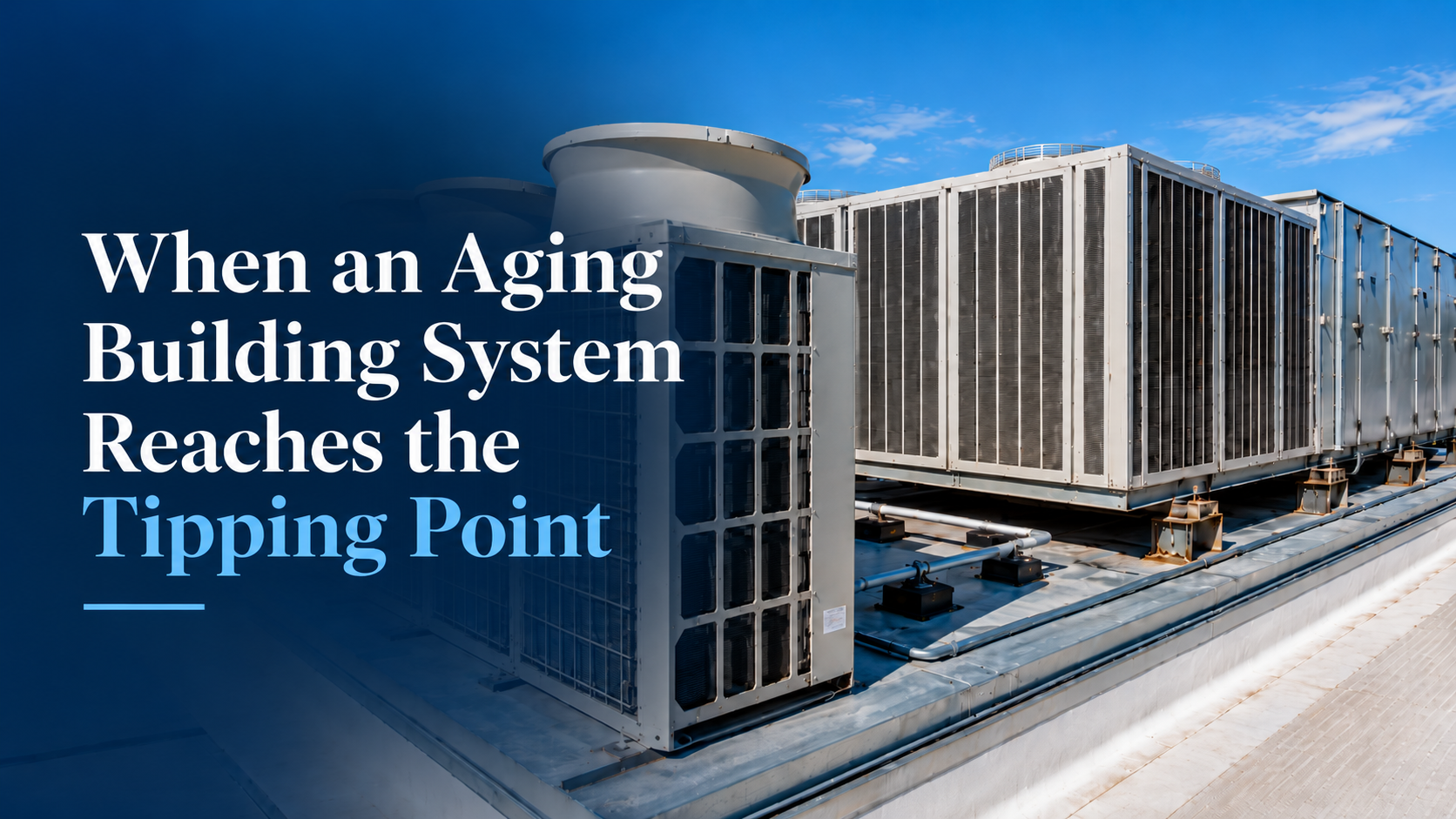
A rooftop HVAC unit that requires one repair after several years of reliable service may still have significant useful life remaining.
That same unit looks very different after multiple service calls, rising repair costs, declining efficiency, and repeated tenant comfort complaints.
The equipment may technically still be repairable in both situations.
The ownership decision should not necessarily be the same.
Operating Cost Is Part of the Capital Decision
Older equipment can continue functioning long after it stops operating efficiently.
That distinction is easy to overlook.
An HVAC system may still heat and cool the building while consuming more energy and requiring additional service. Lighting may remain operational while generating higher utility and maintenance costs. An aging control system may demand more manual oversight because it cannot provide the same visibility or automation as a newer system.
These expenses often appear in different areas of a property’s financials.
Maintenance is one expense. Utilities are another. Emergency service may appear somewhere else. Tenant disruption may never show up as a direct line item at all.
Viewed separately, each cost may seem manageable.
Taken together, they can materially change the repair-versus-replace analysis.
The better question is not simply:
What does this repair cost?
It is:
What is this system costing the property to keep?
Reliability Has Value
Commercial buildings exist to support the people and businesses occupying them.
When building systems become unreliable, the impact extends beyond the mechanical room.
Recurring HVAC problems affect tenant comfort. Roof leaks interrupt operations and can damage interiors. Plumbing failures create immediate disruption. Deteriorating parking areas affect how tenants and visitors experience the property. Lighting failures can affect both safety and perception.
A system does not have to fail completely before it begins affecting the asset.
This matters because tenant experience ultimately connects back to property performance.
A tenant considering a renewal may not know the age of a rooftop unit, but they remember repeated temperature issues.
They may not understand the roof assembly, but they remember water intrusion in their space.
Reliability should therefore be part of the capital planning conversation, even when its value is more difficult to quantify than a repair invoice.
Useful Life Is a Guide, Not a Deadline
Commercial building components generally have expected useful lives, but those estimates should not be treated as automatic replacement dates.
Two similar systems installed at the same time can perform very differently depending on maintenance, operating conditions, usage, and environment.
Age matters, but condition matters more.
A well-maintained system that continues to perform reliably may justify continued operation beyond a typical replacement horizon. Another may require significant investment much earlier.
The question is not simply whether a building component is old.
It is whether the remaining useful life justifies continued investment.
As repair expenses rise and reliability declines, ownership should become increasingly cautious about putting significant capital into a system that may still require replacement in the near future.
Is the Tipping Point Getting Closer?
Owners should begin looking beyond the individual repair when several of these conditions start appearing together:
-
- Repairs are becoming more frequent
-
- Annual maintenance costs are trending upward
-
- Parts are increasingly difficult or expensive to source
-
- Downtime is affecting tenants
-
- Energy or operating efficiency is declining
-
- Reliability is becoming unpredictable
-
- Replacement is already expected within the next several years
One issue may justify another repair. Several together may signal that the strategy needs to change.
Planned Replacement Creates Options
One of the biggest differences between proactive capital planning and reactive maintenance is choice.
When a major system fails unexpectedly, ownership’s options immediately narrow.
Work may need to happen quickly. Vendor availability can become more important than competitive pricing. Equipment choices may be limited by lead times. Tenants may already be experiencing disruption. The expense may need to be absorbed regardless of whether it fits comfortably into the current capital plan.
Planned replacement creates a very different environment.
Ownership has time to evaluate alternatives, compare proposals, coordinate work around building operations, and determine how the expense fits within a broader strategy for the property.
The project may also be coordinated with other improvements to reduce disruption or create efficiencies.
Planning does not mean replacing equipment prematurely.
It means understanding what may be coming next so ownership can make the decision on its own terms.
Major systems are also one of the reasons capital planning should begin before an annual budget is finalized. In 2027 Starts Now: What Commercial Property Owners Should Be Reviewing Before Budget Season, we look at why capital needs, operating costs, vendor contracts, and deferred maintenance should already be part of the conversation before the next year’s budget is complete.
The Right Answer Depends on the Owner’s Strategy
The same building system can produce different decisions for different owners.
An owner planning to hold an asset for another fifteen years may place greater value on reliability and long-term operating efficiency.
An owner preparing for a sale may be more focused on reducing deferred maintenance and avoiding an issue during due diligence.
An owner considering a significant repositioning may need to evaluate whether today’s replacement decision fits the property’s future design and use.
Capital decisions should therefore be made within the context of the broader ownership strategy.
As we discussed in What Should Your Commercial Property Look Like Five Years From Now?, decisions around building systems, capital improvements, maintenance, and tenant needs are already shaping where an asset will be several years from now.
This is one of the reasons property management needs to extend beyond work orders and maintenance schedules.
Management should understand not only what is happening mechanically at the property, but how those operating decisions connect to what ownership ultimately wants to accomplish with the asset.
Some Systems Should Be Watched Before They Need to Be Replaced
The best time to begin discussing replacement is often long before replacement is necessary.
A strong capital planning process identifies major systems, understands their approximate age and condition, tracks repair history, and begins forecasting where meaningful expenditures may be required over the next several years.
That does not mean every aging component belongs in next year’s capital budget.
Some systems may remain on a watch list for years.
The value comes from visibility.
If ownership knows that several rooftop units, a parking surface, and a section of roof may all require meaningful investment within the next three to five years, those decisions can be evaluated together.
Without that visibility, each project can feel like an unexpected expense arriving independently.
This is also where proactive property management can create long-term value. Tracking repair history, identifying patterns, and planning ahead gives ownership more time and more options before a capital need becomes an emergency.
Maintain. Monitor. Act.
Not every aging system requires the same response.
A simple way to frame the decision is to think about the asset in three stages:
Maintain
The system is performing reliably, maintenance requirements are reasonable, and continued investment still makes financial and operational sense.
The priority is preventive maintenance and protecting the useful life that remains.
Monitor
Age, repair frequency, operating cost, or reliability is beginning to change the equation.
Replacement may not be necessary today, but the system deserves greater attention and should begin appearing in longer-term capital discussions.
Act
The combination of repair history, cost, reliability, tenant impact, and future capital needs indicates that continued repair may no longer be the strongest long-term decision.
At this point, ownership has enough information to evaluate replacement deliberately rather than waiting for failure to make the decision.
The progression from maintain, to monitor, to act will happen differently for every property.
The important thing is recognizing when the facts have changed enough that the recommendation should change with them.
Know When the Recommendation Needs to Change
For years, the right recommendation may be to maintain and monitor.
Then something changes.
Repair frequency increases. Costs rise. Reliability declines. Parts become difficult to obtain. Tenant disruption becomes more significant. A replacement that once seemed premature begins to look increasingly reasonable.
That is the point property management should be helping ownership recognize.
There is no universal number of repairs, age, or dollar amount that determines exactly when a commercial building system should be replaced.
Every property, system, and ownership strategy is different.
But continuing to repair a system simply because that has always been the approach is not a strategy.
The recommendation should evolve as the information changes.
The Goal Is Not to Replace More. It Is to Plan Better.
Responsible commercial property management does not mean recommending a capital project every time a building component shows its age.
It means giving ownership enough information to understand the decision.
Repair history, operating costs, reliability, remaining useful life, tenant impact, and the long-term plan for the property all belong in that conversation.
Sometimes the right decision will be another repair.
Sometimes replacement will create the better long-term outcome.
The important thing is that ownership understands why.
At Lyonis Management, we believe capital planning should give owners visibility before major decisions become emergencies. Good information helps identify when a system should be maintained, when it should be watched more closely, and when it is time to act.
The goal is not to spend more on a property. It is to make better decisions about where and when to invest.